
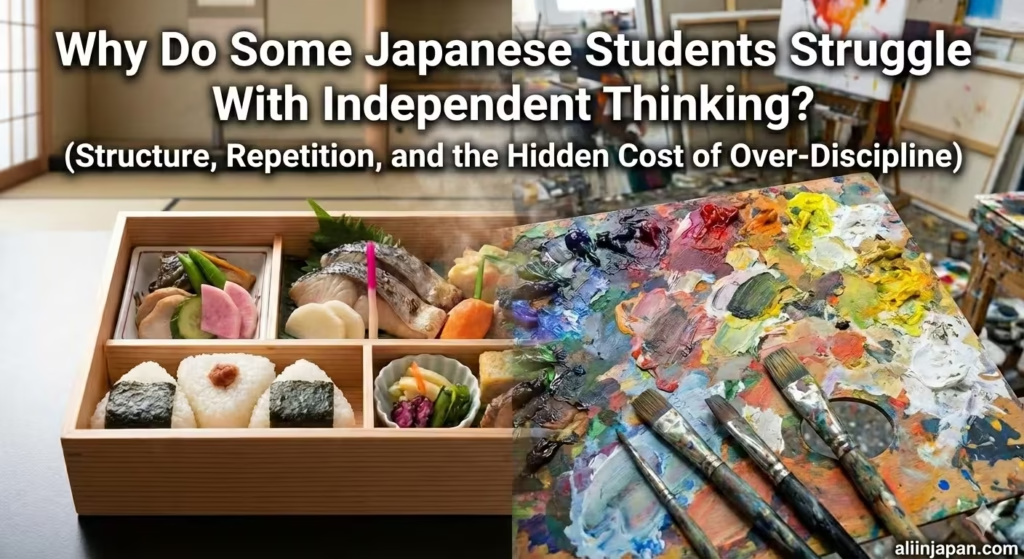
(Structure, Repetition, and the Hidden Cost of Over-Discipline)
A Difficult Observation — But an Honest One
I hesitated before writing this. But after years of living in Japan and working directly with Kyoto University students, I can’t ignore something I’ve consistently observed: Many of them are incredibly hardworking. Disciplined. Polite. Patient.
But when faced with something unfamiliar — something that requires improvisation, quick problem-solving, or independent reasoning — many struggle.
Not all. But enough that it became noticeable. I’ve seen students freeze when instructions weren’t 100% clear, or repeat the same process many times before understanding the logic behind it.
This is about how intelligence is structured and expressed.
1. The Education System: Mastery Through Repetition
Japan’s education system is heavily exam-oriented. From elementary school, the “one correct way” is the only way.
Think about Kanji. To be literate, a student must memorize thousands of characters through Kaki-jun (stroke order). If you write a character perfectly but the stroke order is wrong, it’s often marked as incorrect. From age six, the brain is programmed to believe that how you do something is just as important as the result.
This produces high consistency, but it often kills the “trial and error” spirit. Independent reasoning is not the primary skill being trained; precision is.
2. “Kuuki wo Yomu” (Reading the Air)
In Japan, “independent thinking” isn’t just a cognitive skill; it’s a social risk. There is a famous saying: “Deru kugi wa utareru” (The nail that sticks out gets hammered down).
Beyond the classroom, students are constantly “reading the air” (Kuuki wo yomu). They are scanning the room to see if their opinion aligns with the group. If a student has a creative idea but senses it might disrupt the “Wa” (harmony), they will often keep it to themselves.
What looks like a “lack of initiative” is often a highly sophisticated survival mechanism to protect group harmony.
3. The Fear of Being Wrong (And “Shikata ga nai”)
Many Japanese students would rather do nothing than risk doing something incorrectly. There is also the cultural layer of “Shikata ga nai” (It can’t be helped). If the instructions aren’t there, a student might feel it’s simply impossible to proceed. What looks like passivity is actually a mix of risk avoidance and a cultural acceptance of systemic limits.
🌟 The Flip Side: Why This System Works
It’s easy to criticize this “robotic” approach, but we must look at what this system gives to the world. This same “struggle with improvisation” is what makes Japan one of the most functional societies on Earth.
- Reliability: When you have a system built on repetition and precision, you get the Shinkansen (bullet trains) that are never late.
- Quality Control: The Japanese “Monozukuri” (craftsmanship) spirit comes from this exact discipline. They don’t “guess”; they follow the process until it’s perfect.
- Public Safety: A society that prioritizes “reading the air” and following rules is a society where you can leave your wallet on a cafe table and find it there an hour later.
The downside is slow adaptation, but the upside is world-class consistency.
💡 How to Bridge the Gap: Practical Tips
If you are a foreigner working or teaching in Japan, you’ve likely felt the same frustration I did. Here is how I changed my approach to get better results:
- Don’t Ask “Any Ideas?”, Give Options: Instead of an open-ended “What should we do?”, try: “Should we go with Path A or Path B? Why?” This provides a “safe zone” for their reasoning.
- The “Sandbox” Method: Explicitly tell them: “In this meeting, there are no wrong answers. It is okay to fail.” You have to give them “permission” to be messy.
- Provide a Clear “Base”: Use what I call the Hybrid Bridge. Give them 70% of the structure (the steps they are comfortable with) and leave 30% for their own improvisation.
- One-on-One Feedback: Never put a student on the spot in front of the group. They are much more likely to show independent thinking in a private, low-stakes environment.
My Personal Frustration — And What It Taught Me
I’ll be honest. At times, I thought: “Why don’t you just try?” But I was measuring them using my Western cultural framework. Japan trained them for a system where structure prevents chaos.
Once I stopped trying to turn them into “Western-style disruptors” and started respecting their “process-oriented mastery,” the relationship changed.
Final Thoughts: Not Robots — Just Highly Conditioned
Japan produces extremely reliable people, detail-oriented thinkers, and process masters. The Western world could use more of their discipline. Japan could use more permission to experiment. The truth, as always, is somewhere in between.
Related internal read:
👉 https://aliinjapan.com/why-japans-work-culture-is-changing-and-what-it-means-for-foreigners/
Discover more from Ali in Japan
Subscribe to get the latest posts sent to your email.