When I first attended a Japanese tea ceremony in Kyoto, I thought it was just about drinking matcha.
I couldn’t have been more wrong.
After living in Japan for over five years, I now understand that the tea ceremony — or chanoyu (茶の湯) — is not just about tea.
It’s about presence, respect, and connection — three things Japan does better than almost anywhere else in the world.
🍃 A Ceremony That Teaches You to Slow Down
In Japan, life can feel incredibly fast-paced. Trains are punctual to the second, people move efficiently, and silence often replaces small talk.
But inside a tea room, time slows down.
Before entering, you wash your hands and bow — symbolically leaving the outside world behind.
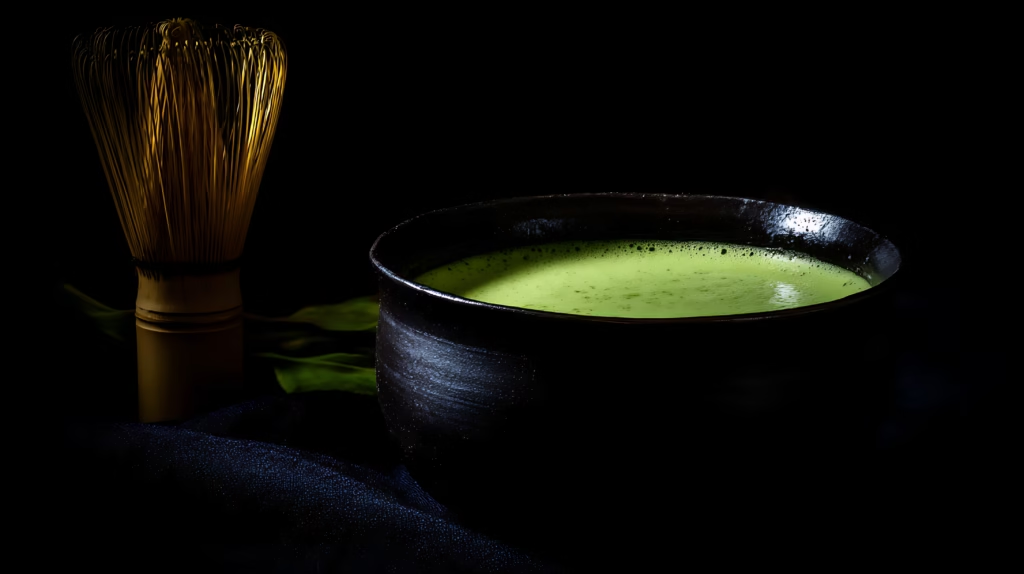
The host prepares every movement with purpose: the whisking of matcha, the placement of utensils, even how the cup is rotated before being served.
There’s no rush.
No unnecessary noise.
Just intentional silence — a rare gift in modern life.
Related: 🧘♀️ The Japanese Concept of Wabi-Sabi: Finding Beauty in Imperfection
🍵 The Four Pillars: Harmony, Respect, Purity, and Tranquility
Every tea ceremony follows the principles established by Sen no Rikyū, the tea master who shaped modern tea culture.
He called them Wa (和), Kei (敬), Sei (清), and Jaku (寂) — Harmony, Respect, Purity, and Tranquility.
It’s not philosophy for philosophy’s sake — it’s a lifestyle.
- Harmony (Wa): The connection between people, nature, and space.
- Respect (Kei): Gratitude for everyone involved — the host, the guest, even the utensils.
- Purity (Sei): Cleansing the heart and mind before entering the tea room.
- Tranquility (Jaku): The state of calm that naturally emerges when the first three are achieved.
When I sat through my first ceremony, I didn’t understand any of this. But by the second or third time, I noticed how it quietly reshaped how I approached everything — even something as small as making coffee in the morning.
Learn more: Urasenke Foundation – The Way of Tea
🪷 The Beauty of Imperfection
The tea bowl, or chawan, is often slightly uneven.
Its glaze might drip, its surface might be rough, and that’s intentional.
It’s Wabi-Sabi — the beauty of imperfection.
As a foreigner, I used to think perfection was about flawless symmetry.
But in Japan, perfection is found in sincerity.
Even the act of serving tea reflects that — a small ritual done with heart, not just habit.
There’s humility in it, and it feels honest in a way that’s almost spiritual.
Related: 🏡 How Japanese Minimalism Changed My Life (And Why the West Got It Wrong)
🕯️ More Than Tradition — A Form of Meditation
The tea ceremony isn’t stuck in the past.
In fact, it feels surprisingly modern when you experience it firsthand.
Sitting quietly, listening to the sound of boiling water, watching each movement flow naturally — it’s like meditation for the senses.
There’s no phone, no small talk, no pressure to perform.
It’s just you, the host, and the moment.
As someone who spent years chasing productivity, this ceremony taught me something precious:
“Efficiency isn’t everything. Presence is.”
🌸 Experiencing It in Kyoto
If you ever visit Japan, Kyoto is the best place to experience chanoyu.
Small tea houses in Gion, Uji, and Arashiyama still practice traditional ceremonies daily.
One of my favorites is at Camellia Tea House near Kiyomizu-dera — a quiet, authentic experience where the host explains each step in English.
You can even try preparing your own bowl of matcha under their guidance.
External link: Camellia Tea Ceremony Kyoto
💬 What It Teaches About Japanese Life
Living in Japan, I’ve realized the tea ceremony reflects everything about this culture:
discipline, grace, respect for time, and awareness of beauty in simplicity.
It’s not about tea — it’s about mindset.
The same calmness you feel in a tea room exists in the way people bow, handle money, or care for a garden.
And that’s the true charm of Japan — it teaches peace without saying a word.
Discover more from Ali in Japan
Subscribe to get the latest posts sent to your email.